

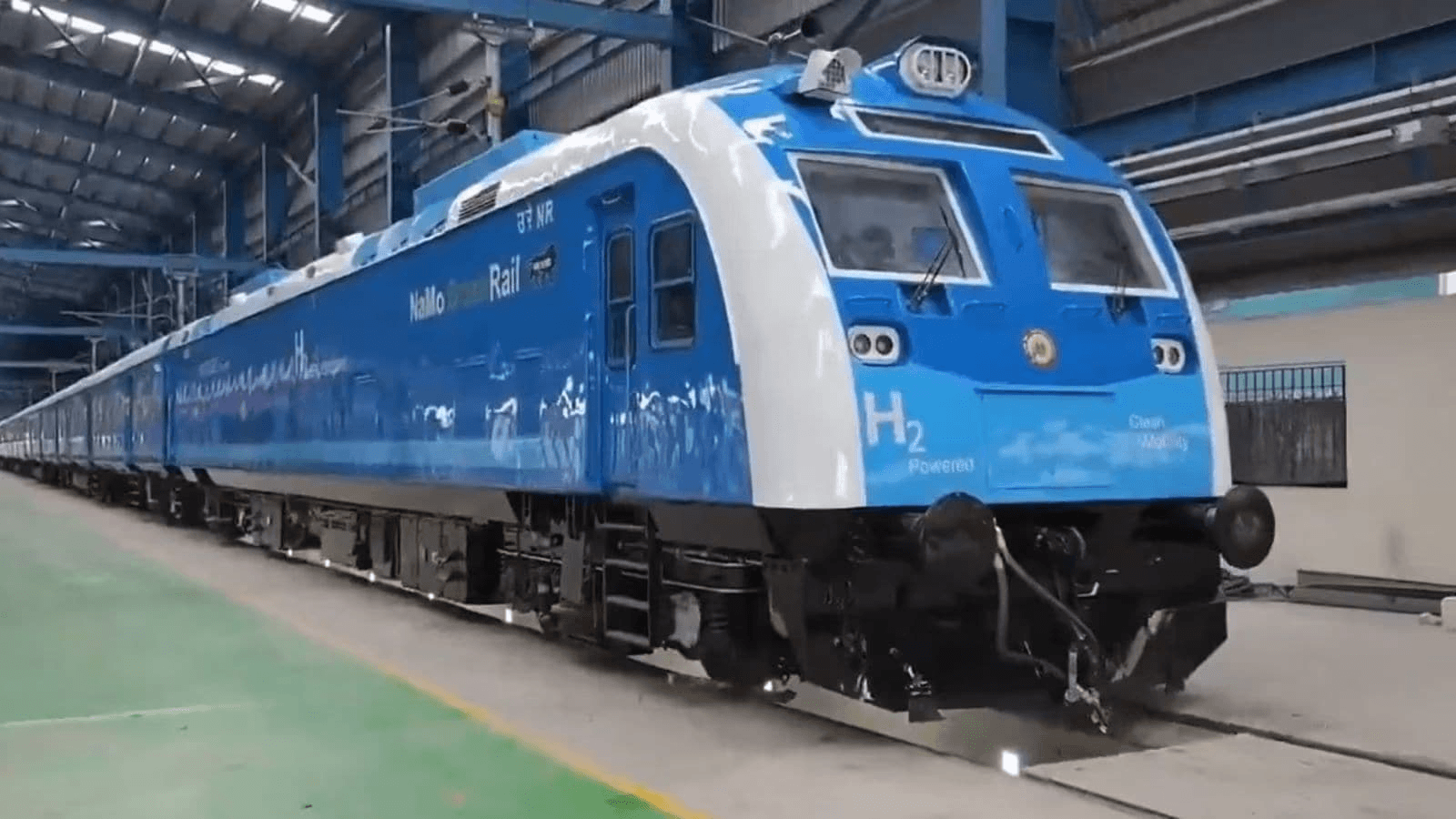
The Ministry of Railways has approved the operation of India’s first hydrogen-powered 10-coach DEMU train on the Jind-Sonipat section under the Northern Railway zone, marking a major step towards cleaner and sustainable railway transportation.
The train will operate using hydrogen fuel cell technology instead of diesel or conventional electric traction and will run at a maximum speed of 75 kmph. With a total power output of 1,200 kilowatts, the train is based on Distributed Power Rolling Stock (DPRS) technology, where power is distributed across multiple coaches rather than generated through a single locomotive.
The approval came after technical clearance from the Research Designs and Standards Organisation (RDSO) and safety inspections conducted by the Commissioner of Railway Safety. Railway authorities have also been directed to comply with all operational and safety norms prescribed by statutory agencies, including the Petroleum and Explosives Safety Organisation (PESO).
Officials clarified that passenger operations will not begin immediately as several compliance checks and verification procedures are still underway. Maintenance facilities for the train have been established at Shakurbasti in Delhi, while the hydrogen-powered service will initially operate only on the Jind-Sonipat route.
The ministry has also mandated specialised training and competency certification for railway staff involved in hydrogen refuelling and onboard operations. During maintenance movement, the hydrogen systems will remain shut down and the train will be hauled using a diesel locomotive.
India’s move comes as several countries are increasingly adopting hydrogen-based transport technology to reduce carbon emissions. Germany became the first country in the world to commercially operate a hydrogen-powered passenger train through the Coradia iLint model developed by Alstom. The first commercial hydrogen train service began on September 17, 2018, in Lower Saxony in northern Germany.
In August 2022, Germany launched the world’s first fully hydrogen-powered railway line using the Coradia iLint trains. One of the key environmental advantages of hydrogen-powered trains is that they produce only water vapor as emission, making them a zero-emission alternative to conventional diesel-powered rail systems.
The Indian Railways project is being viewed as a significant milestone in the country’s broader efforts to modernise railway infrastructure and promote environmentally friendly transport technologies.


