

Researchers at Indian Institute of Technology Guwahati have developed an advanced light-emitting perovskite nanomaterial that could significantly strengthen protection against counterfeit currency, forged documents, and fake consumer products.
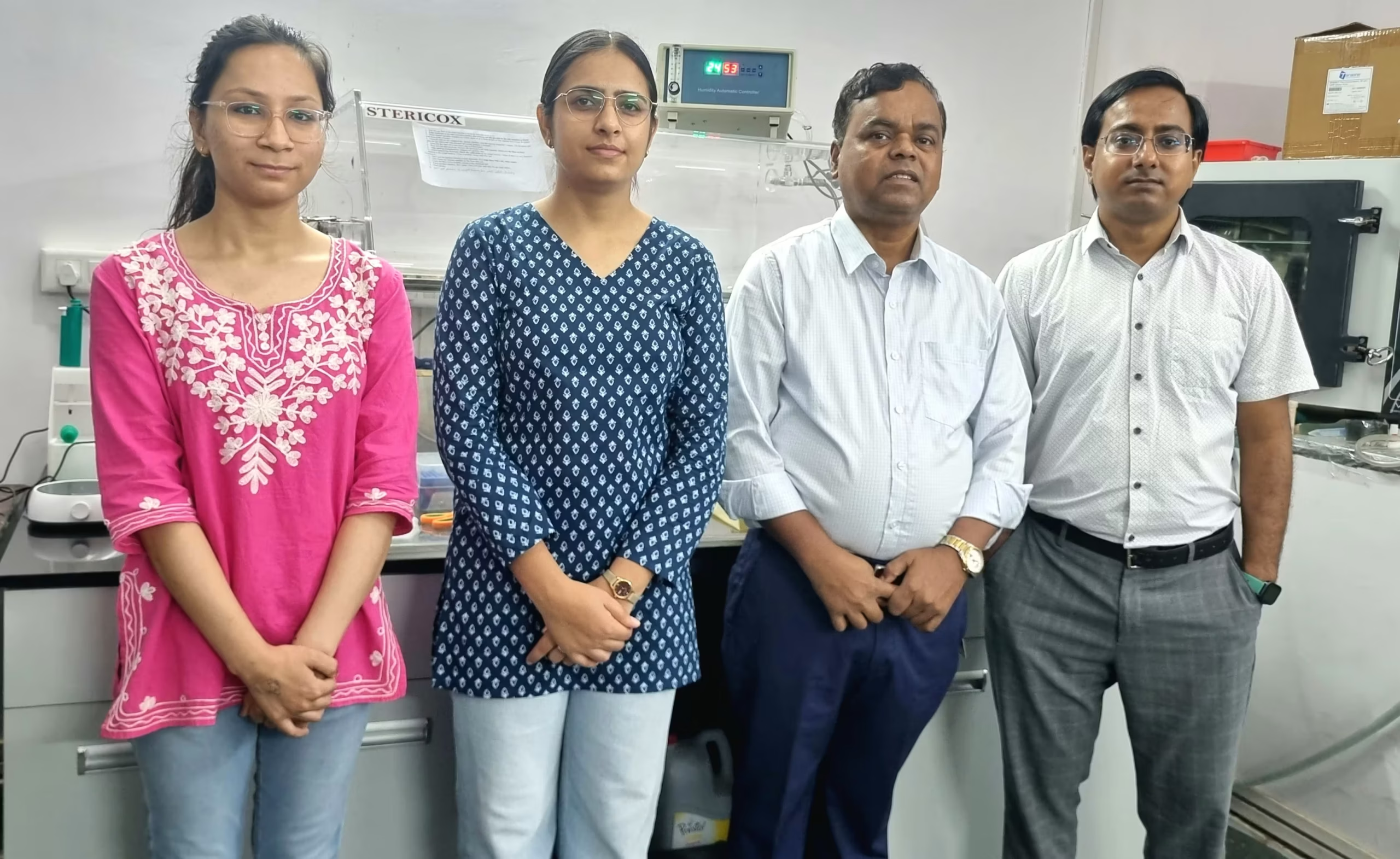
The breakthrough research has been published in the prestigious Advanced Optical Materials journal. The study was conducted by Saikat Bhaumik in collaboration with P. K. Giri and research scholars Latika Juneja and Garima Choudhary from the Department of Physics.
Counterfeiting remains a growing global challenge affecting sectors ranging from banking and identity documentation to pharmaceuticals, electronics, and luxury goods. Traditional security measures such as barcodes, QR codes, holograms, and watermarks are increasingly vulnerable to replication using advanced technologies.
To address this challenge, the IIT Guwahati team developed light-emitting perovskite nanocrystals, microscopic crystalline materials known for their exceptional optical and electronic properties. These nanocrystals can generate highly pure and intense colours with extremely narrow emission ranges, creating unique optical signatures that are difficult to replicate.
One of the key challenges associated with perovskite materials is their tendency to degrade when exposed to heat, moisture, and environmental conditions. To overcome this limitation, the researchers engineered a double-layer protective coating around the nanocrystals, significantly improving their thermal and chemical stability while preserving their light-emitting capabilities.
Using a direct laser writing technique, the team then created microscopic security patterns from these coated nanocrystals. The technology allows the creation of highly complex designs with resolutions ranging between 10 and 40 micrometres without requiring conventional lithographic masks.
According to Prof. Saikat Bhaumik, the developed material behaves differently from conventional security labels. Instead of displaying a static fluorescent mark, the nanocrystals respond predictably to environmental changes. For example, a hidden fluorescent pattern can be erased through heating and later regenerated through a specific chemical treatment.
This unique behaviour means that counterfeiters would need to replicate not only the visible pattern but also the material’s precise response to heat and chemical processes, making duplication significantly more difficult.
The research team has termed the technology “4D anticounterfeiting,” as it incorporates dynamic responses in addition to visual security features.
Beyond security applications, the laser-patterning technique developed during the research could also contribute to future advancements in micro-LED displays used in smartphones, wearable devices, and augmented reality (AR) systems.
Researchers believe the technology has wide-ranging applications, including securing banknotes, passports, identity cards, legal documents, luxury products, and other items where authentication and anti-counterfeiting measures are critical.