
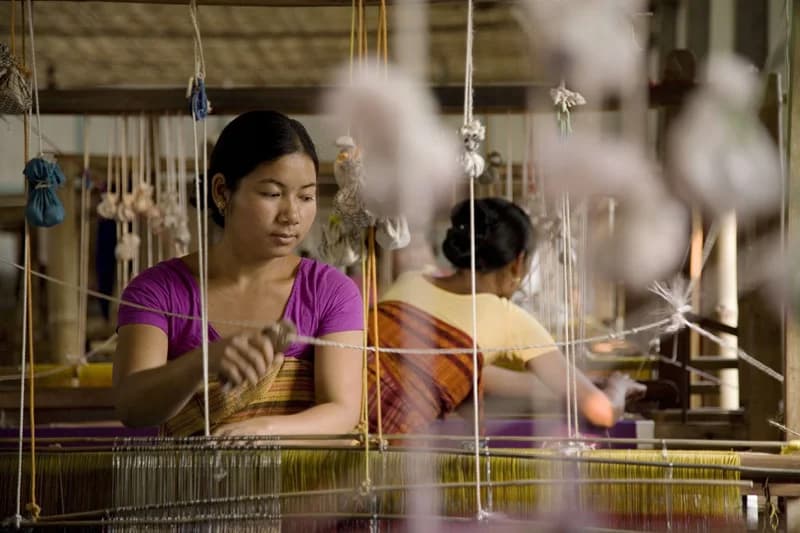
Assam has long celebrated its handloom heritage as a symbol of culture and identity. Every household weaving a gamosa or a mekhela chador has become part of the state's collective image. Yet, beyond the cultural narrative lies an economic reality that deserves far greater attention: Assam is not just a handloom-rich state—it is India's largest handloom economy by workforce.
According to the Fourth All India Handloom Census (2019-20), Assam has 12,83,881 handloom workers, the highest in the country. The state alone accounts for 11,07,428 weavers and another 1,76,453 allied workers engaged in winding, warping, dyeing and finishing. To put this into perspective, West Bengal, which ranks second nationally, has 6,31,447 handloom workers—roughly half of Assam's workforce.
The numbers become even more remarkable when viewed from a social perspective. Nearly 92 per cent of Assam's handloom workforce comprises women. More than 11.79 lakh women are engaged in weaving and allied activities, making handloom one of the state's largest women-led economic sectors. With 12.69 lakh handloom households and nearly 12.46 lakh looms, weaving is deeply embedded in Assam's rural economy and household livelihoods.
The diversity of production further reflects the state's unique textile identity. Around 6.16 lakh weavers produce mekhela chadors, while 3.55 lakh specialise in gamosas. More than 54,000 weavers work with Muga silk and over 43,000 with Eri silk, strengthening Assam's globally recognised silk ecosystem.
These figures firmly establish Assam as the country's undisputed handloom leader. However, they do not necessarily prove that the sector is experiencing a "boom."
The same census reveals that the average handloom worker is engaged in weaving for only 171 days a year. For nearly half the year, many weavers depend on agriculture or other sources of income. This suggests that while Assam possesses unmatched production capacity, employment remains seasonal and incomes are often uncertain.
The real question, therefore, is not whether Assam has enough looms. It is whether its weavers have enough work, enough markets and enough income.
Recognising this gap, recent government initiatives indicate a strategic shift from preserving traditional weaving to building an integrated handloom economy.
One of the most significant interventions is the ₹31.01-crore Sivasagar Mega Handloom Cluster. Rather than focusing solely on household production, the project introduces shared infrastructure such as spinning units, common facility centres and retail outlets. The objective is to help weavers access better technology, improve productivity and strengthen market linkages.
A similar approach is visible in the Craft Handloom Village at Mohpara in Golaghat, completed in March 2024. The project attempts to integrate weaving with tourism, creating opportunities that extend beyond conventional textile production.
The state's ambitions became even more evident with the announcement of a ₹56-crore integrated handloom centre at Bokakhat. Designed to handle multiple stages of the value chain—from thread extraction and dyeing to weaving, finishing and marketing—it reflects a broader vision of transforming Assam into a complete textile production hub rather than merely a supplier of woven products.
Most recently, the Handloom Trade Centre at Dibrugarh has been developed to improve market access for indigenous products from Upper Assam, potentially reducing dependence on intermediaries and giving weavers greater visibility.
Policy initiatives introduced in the Assam Budget 2025-26 reinforce this direction. Programmes such as Swanirbhar Naari, the Integrated Handloom Park at Kaziranga, the Sualkuchi Silk Yarn Bank, the Assam Silk Outreach Mission, Handloom Model Villages and integrated handloom, handicraft and khadi centres across districts indicate a growing emphasis on infrastructure, market access and institutional support.
Among these, the Swanirbhar Naari initiative offers measurable progress. Government data shows that more than 5.64 lakh weavers have registered on the portal, while over 11 lakh handloom products have already been marketed through the platform. More than 8,000 weavers have also benefited from NABARD-supported skilling, enterprise development and producer-organisation initiatives, backed by grants exceeding ₹5.28 crore.
These developments indicate that Assam is gradually moving away from viewing handloom as a household craft and towards treating it as an organised economic sector with stronger value chains.
Yet, significant challenges remain.
Higher production does not automatically translate into higher incomes. Infrastructure projects alone cannot ensure prosperity unless they are accompanied by sustained demand, competitive branding, better product design, wider export opportunities and assured market access. The success of Assam's handloom sector must ultimately be measured not by the number of looms installed but by whether weavers receive year-round employment, fair prices and rising household incomes.
Assam already possesses what many states aspire to build—a massive workforce, skilled artisans, unique silk traditions and globally recognised products. The foundation is firmly in place.
The next chapter will depend on whether the state's investment in infrastructure, market reforms and value-chain development can transform India's largest handloom workforce into India's most prosperous handloom economy. That, more than the impressive statistics, will determine whether Assam's handloom story truly deserves to be called a boom.